← back to library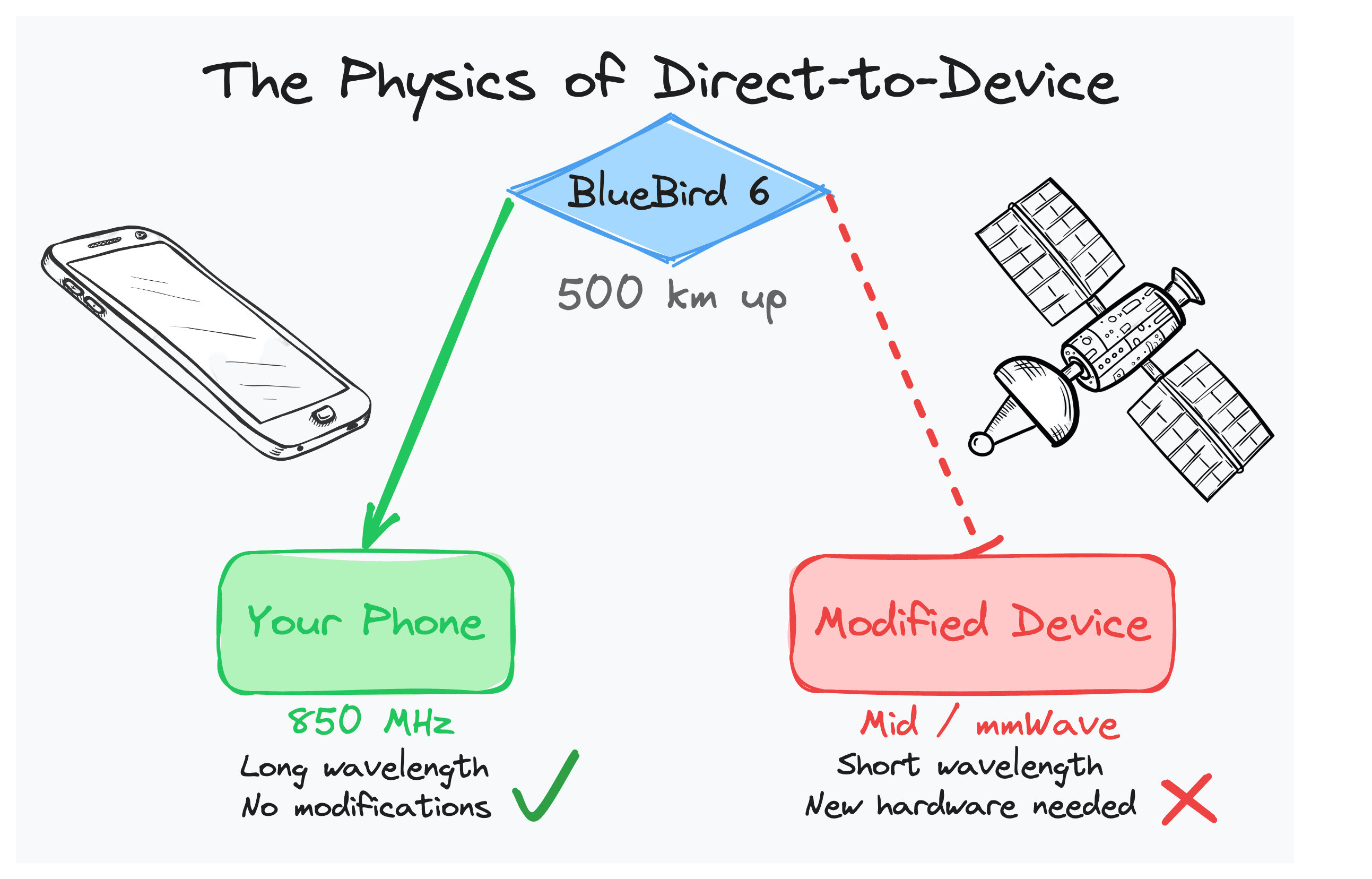
Orbital Spectrum
AST SpaceMobile: why 850 MHz was the only choice
Mar 12, 2026 · 4,000+ impressions
Verizon and AT&T both gave AST SpaceMobile access to the same thing: 850 MHz spectrum. Not mid-band. Not mmWave. That choice is pure physics.
A signal from a satellite 500 km above Earth has to reach a phone transmitting at a fraction of a watt through a fingernail-sized antenna. At higher frequencies, that link budget? Well it breaks. The signal attenuates faster, struggles through foliage, walls, and demands a larger antenna or more power on either end.
At 850 MHz, the wavelength is long enough to maintain a viable link over that distance to a standard smartphone. No specialized hardware or modified chipset. Effectively the phone doesn't know it's talking to a satellite, it thinks its found a cell tower.
On the other hand higher frequencies would deliver more bandwidth per beam but would require modified devices, which breaks the carrier's business models. You can't ask over 60% of U.S. mobile subscribers to buy a new phone to support this new feature.
850 MHz is why AT&T and Verizon signed. It's why the phone in your pocket already works. And it's why the nearly 2,400 sq ft phased array on BlueBird 6, (the largest commercial communications array deployed in LEO) is sized the way it is: the aperture compensates for what low-band spectrum gives up in throughput.
The constraint defines the architecture. The architecture defines the moat.