← back to library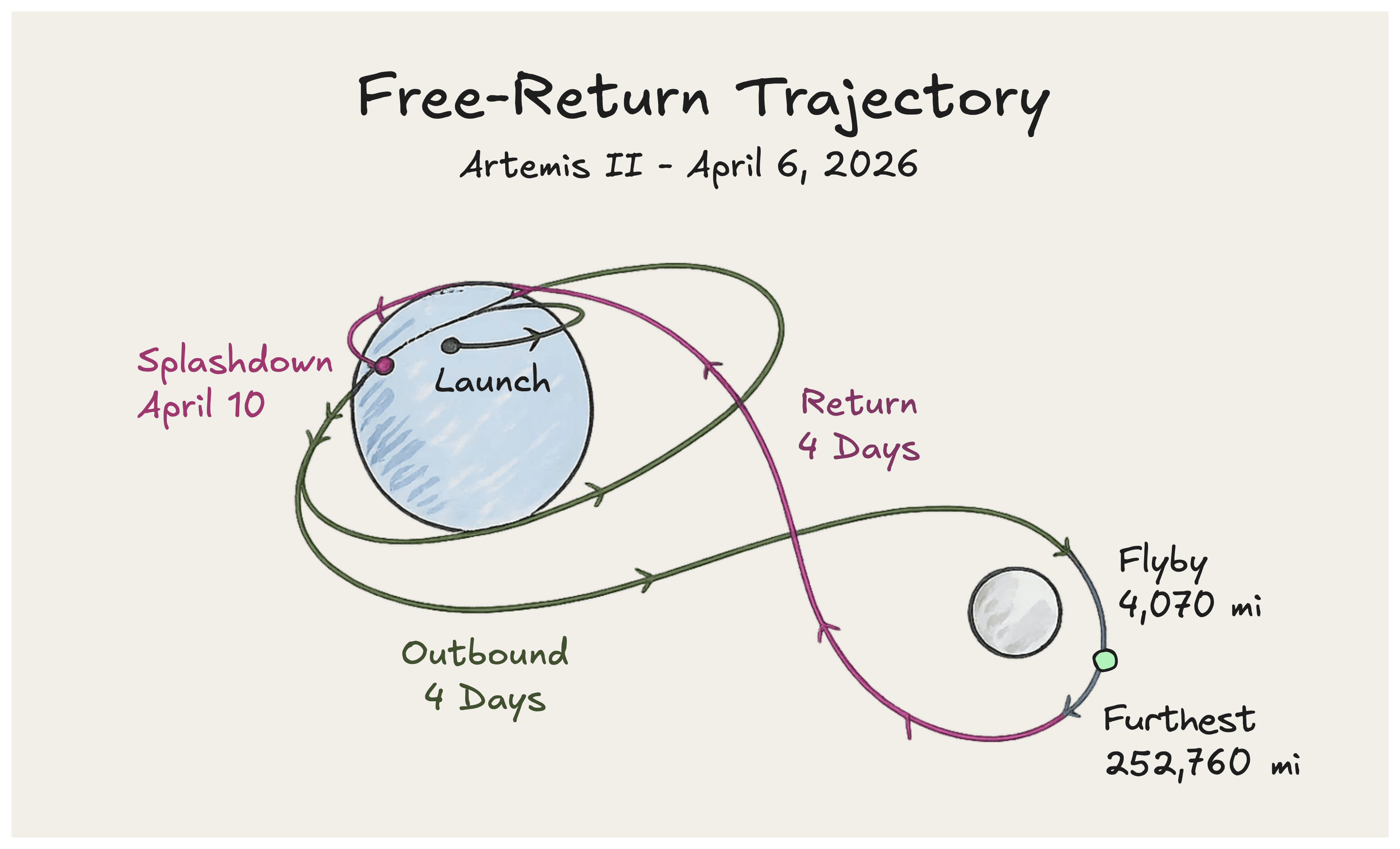
Propulsion & Engineering Physics
The Artemis II free-return trajectory: when failure is the default path home
Apr 6, 2026 · 1,000+ impressions
Four astronauts are flying behind the Moon right now. For ~40 minutes today, no signal can reach them. They will be the most isolated humans ever.
And yet, the path home was never in question.
Artemis II is flying a free-return trajectory. It's an orbital path designed so that if every system on the spacecraft fails after the translunar injection burn, the Moon's gravity alone will send the crew back to Earth. No engine required.
The spacecraft is essentially falling in a figure-eight. Earth's gravity pulls it out, the Moon bends the path, and the geometry returns it home. The math was first proven by the Soviet Luna 3 mission in 1959 and refined for Apollo 8 in 1968.
The free-return concept is elegant because of what it assumes: failure. The entire trajectory is built around the premise that propulsion may not be available when you need it most. Rather than relying on the engine to correct course after the flyby, the flight path itself helps ensure return. Or in other words the Moon does the work.
This is why Artemis II never enters lunar orbit. Unlike Apollo 8 and Apollo 10, which orbited the Moon, Artemis II swings around the far side and lets gravity redirect it home. That choice limits what the mission can do at the Moon. It also means the crew is never one malfunction away from being stranded in lunar orbit.
Apollo 13 famously survived because the crew manually maneuvered back onto a free-return trajectory after their oxygen tank exploded. They weren't on one when the failure happened. NASA had switched to a hybrid trajectory to reach a specific landing site. When the explosion forced an abort, the first critical step was getting back onto the free-return path. The lunar module's engine fired for 38 feet per second of delta-v. That single correction is what brought them home.
Artemis II doesn't need that correction. It's on the free-return from the start.
At 7:02 PM Eastern tonight, Orion will pass 4,070 miles above the lunar surface. At 7:07 PM, the crew will reach 252,760 miles from Earth, the farthest any human has ever traveled. And the trajectory that carries them there is the same one that guarantees their return.
NASA chose a flight path where the default outcome of total failure is: you come home.