← back to library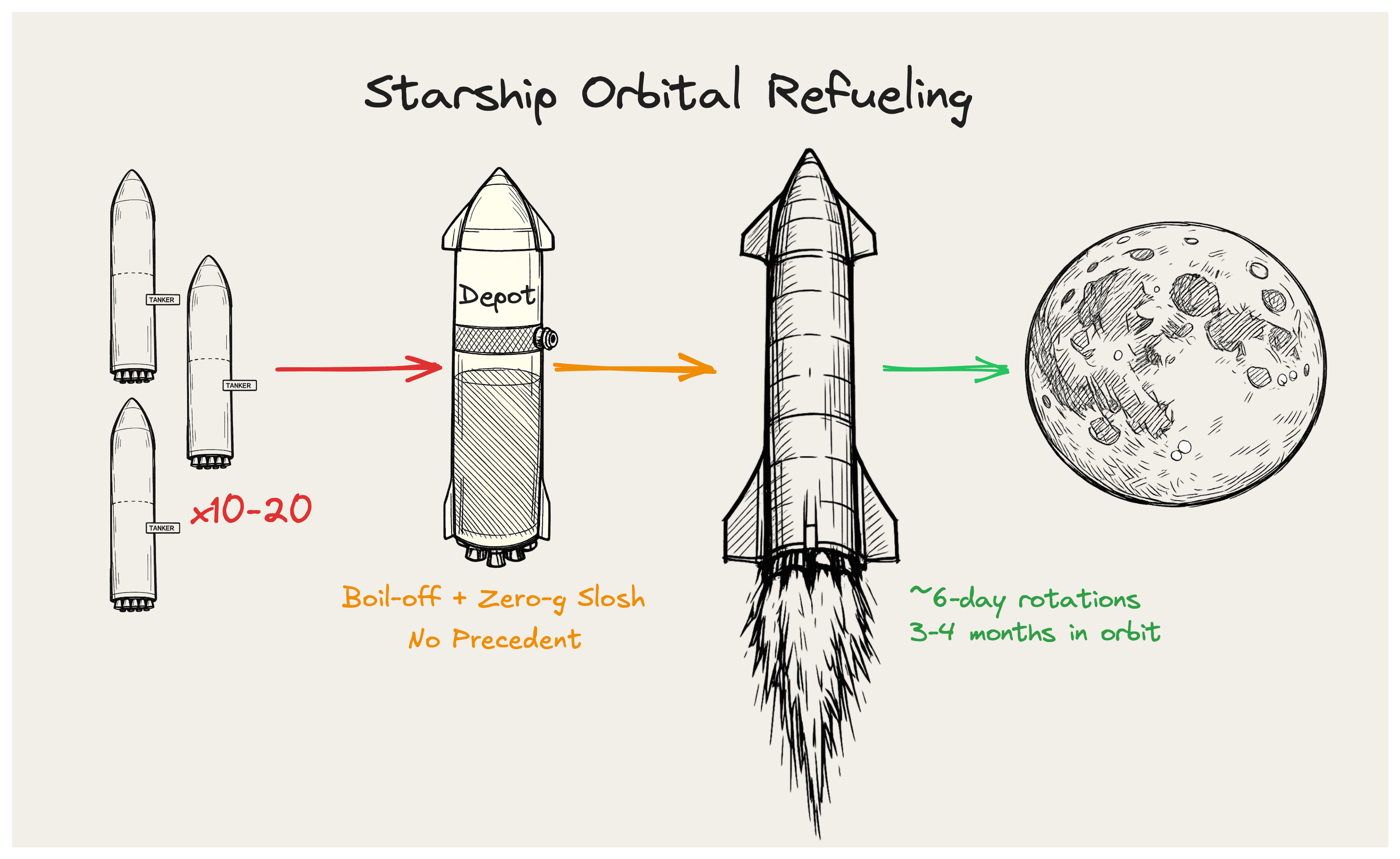
Propulsion & Engineering Physics
Starship's Artemis bet: the cryogenic fuel problem is the engineering problem
Mar 30, 2026 · 26,000+ impressions
SpaceX just became the de facto sole architecture for NASA's initial $20B moon base. But the hardest engineering problem might not be the rocket.
NASA restructured Artemis in early 2026. Boeing's SLS role was reduced. Gateway was paused. Starship is now the primary system for crew descent, ascent, and orbital propellant transfer. One vehicle. One provider. The most ambitious human spaceflight program since Apollo now runs through Hawthorne, California.
That is an enormous vote of confidence in SpaceX. It is also an enormous engineering bet. Starship's lunar mission profile depends on something no one has demonstrated at scale: cryogenic propellant transfer between two vehicles in orbit at scale.
But what does that actually mean? Well, liquid oxygen and liquid methane boil. Without active thermal management in vacuum, cryogenic propellants lose usable mass every hour they sit in a tank.
On Earth, that's pretty manageable. You fuel a rocket and launch the same day. In orbit, the math changes. Starship needs propellant from a fleet of tanker flights launched on roughly 6-day rotations. NASA has indicated the number required is in the high teens. That fuel must hold at cryogenic temperatures for days or weeks before Starship fires a translunar injection burn.
That changes it from a pure scheduling challenge to a thermodynamics problem.
Zero-gravity fluid behavior adds another layer. In microgravity, surface tension dominates over gravity. Propellant sloshes, forms bubbles, and migrates unpredictably inside the tank. NASA has confirmed SpaceX still needs to fully characterize slosh dynamics, ullage management, and settling thrust before transfer begins. SpaceX successfully moved propellant between internal tanks on a single vehicle during Flight Test 3. Ship-to-ship transfer at lunar mission scale doesn't have operational precedent.
The propellant transfer demonstration is a contractual milestone SpaceX must complete before any crewed lunar landing.
If anyone can solve it, SpaceX can. Propulsive landing, rapid booster reuse, fairing recovery. They have a track record of making the impossible routine. But those were execution problems where the physics was well characterized. Cryogenic transfer at this scale sits in a different category. The physics is understood... in theory. The engineering though has not been validated in practice at scale.
Blue Origin is under contract as a second HLS provider starting with Artemis V. But for the first crewed landing, no alternative lander is qualified and ready.
The moon base doesn't have a rocket problem. It has a fuel problem that starts the moment the tanker reaches orbit.