← back to library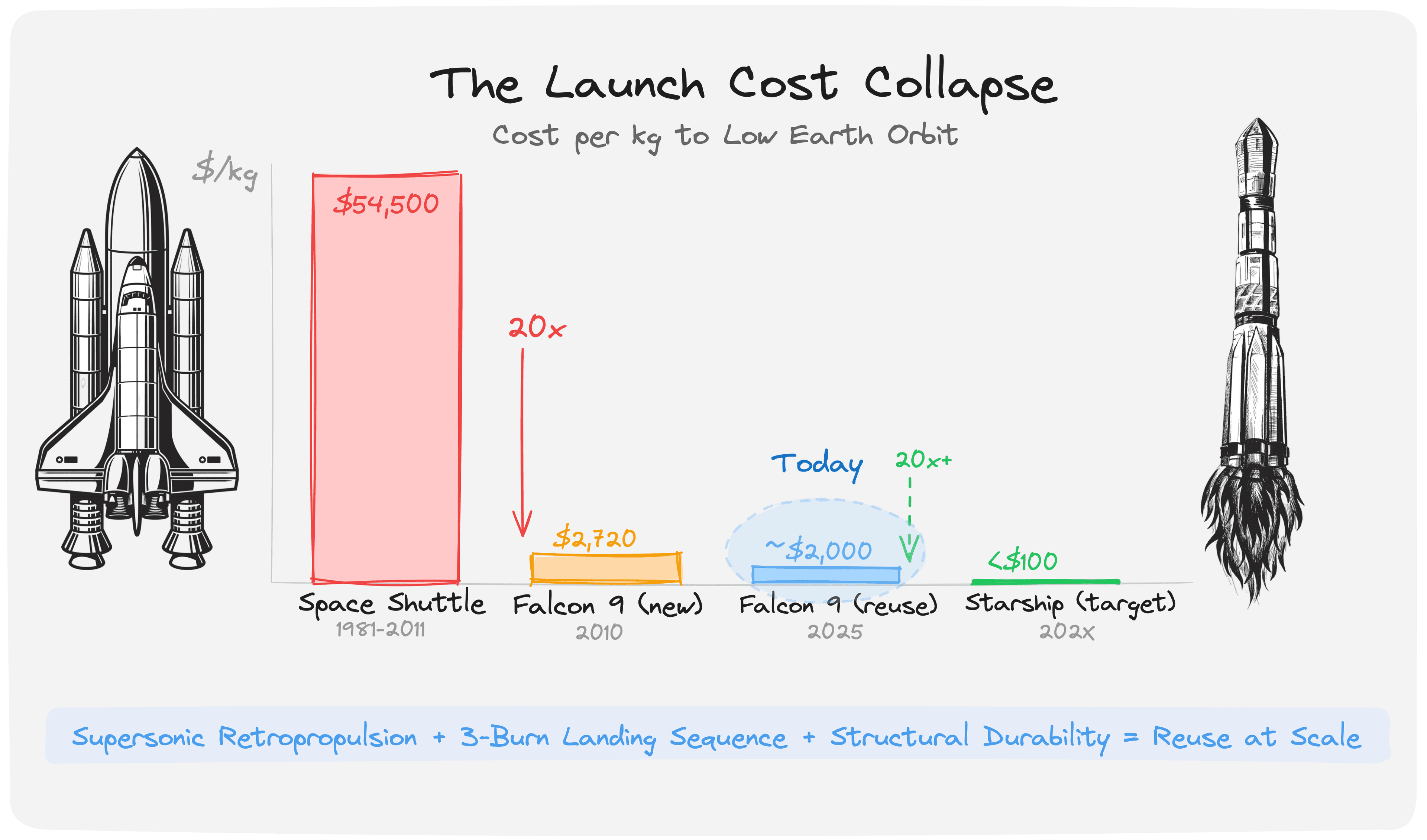
Launch Economics
SpaceX's 33rd booster landing and the compounding cost curve
Mar 10, 2026 · 62,000+ impressions
SpaceX just landed a booster for the 33rd time. For decades, the industry didn't think reuse was worth the trade-off at all.
Reusable rockets have reshaped launch economics. But the engineering that made this possible is rarely discussed, and it explains why the cost curve has significantly further to fall.
For decades, orbital rocketry operated under a constraint called the Tsiolkovsky rocket equation. Every kilogram of hardware you want to bring back is a kilogram that doesn't go into orbit. Reserving 15-20% of propellant for a return flight directly cuts payload capacity. For most of the space age, it was cheaper to build new than to fly back.
SpaceX changed that logic by solving problems that hadn't been done at scale. So what did they actually solve?
1) Supersonic retropropulsion. When the Falcon 9 booster begins its return, it is traveling above Mach 5. To decelerate, it fires engines directly into the oncoming supersonic airflow, creating complex shock interactions between the exhaust plume and atmosphere that had only been studied theoretically. NASA researched this for Mars landers. SpaceX showed it works on Earth and has now executed it over 580 times.
2) The landing sequence. After stage separation, the booster executes a boostback burn to change course toward the landing zone. A reentry burn ignites three of the nine engines to reduce velocity and manage thermal loads as the vehicle descends through the atmosphere. A single-engine landing burn handles precision guidance. Between burns, titanium grid fins steer the craft. The entire sequence is autonomous.
3) Structural durability. The booster endures hypersonic reentry, extreme thermal cycling, acoustic loads from nine engines at liftoff, and landing impact, then flies again roughly 40 days later. Block 5 was designed for 10 flights with minimal inspection. The current record is 33 on a single airframe.
So what are the economic results? Launch costs have fallen from $54,500/kg in the Shuttle era to roughly $2,000/kg today. Booster refurbishment runs a fraction of new build cost. With roughly 18 active boosters supporting 165 annual launches, the fleet operates more akin to commercial airlines.
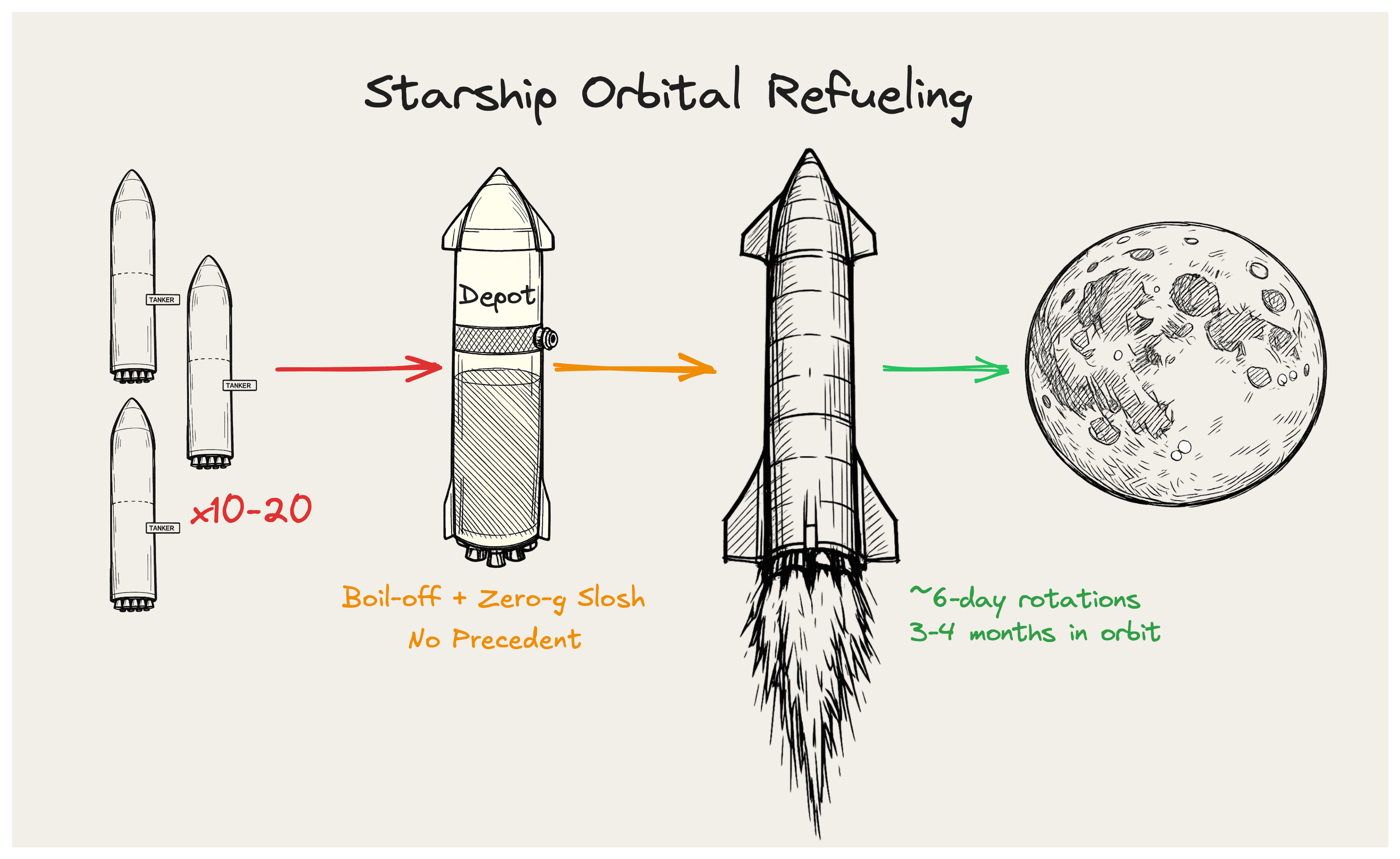
The next generation pushes this even further. Starship targets full reusability of both stages, with the booster caught mid-air by the launch tower, eliminating landing legs entirely and compressing turnaround from weeks toward days.
At $20,000/kg, only governments built constellations. At $2,000/kg, commercial and sovereign programs have access. At $200/kg, applications that don't yet have business models are viable.
The cost curve is compounding. And the floor is not yet clear.
What does launch economics look like at $100/kg, and what gets built that cannot be built today?